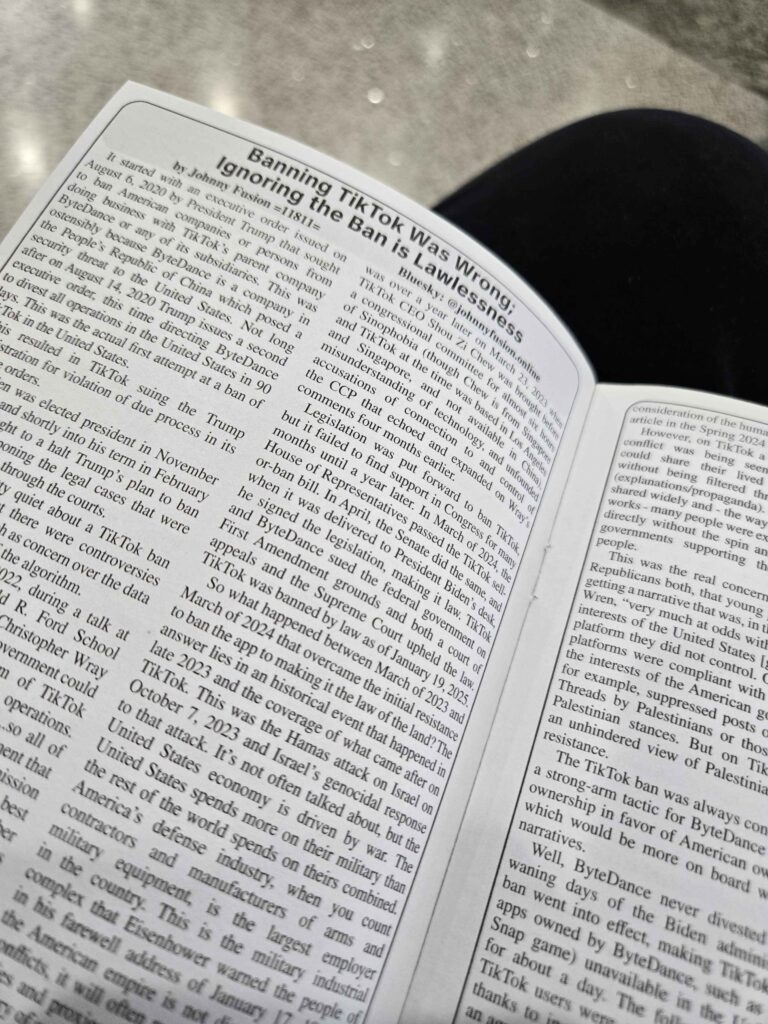
Banning TikTok Was Wrong; Ignoring the Ban is Lawlessness

This article first appeared in the Autumn 2025 issue of 2600 The Hacker Quarterly

It started with an Executive Order issued on August 6, 2020, by President Trump that sought to ban American companies or persons from doing business with TikTok’s parent company ByteDance or any of its subsidiaries. This is ostensibly because ByteDance is a company in the People’s Republic of China which posed a security threat to the United States. Not long after, on August 14, 2020, Trump issues a second Executive Order, this time directing ByteDance to divest all operations in the United States in 90 days. This is the actual first attempt at a ban of TikTok in the United States.

This results in TikTok suing the Trump administration for violation of due process in its executive orders.

Joe Biden is elected president in November of that year and shortly into his term in February 2021, he brings to a halt Trump’s plan to ban TikTok by postponing the legal cases that were working their way through the courts.

Things were pretty quiet about a TikTok ban for a good while, but there were controversies about the app, such as the data it collected and behavior of the algorithm.

Then on December 2, 2022, during a talk at Michigan University’s Ford School of Public Policy FBI Director Christopher Wray raises concerns that the Chinese Government can use the recommendation algorithm of TikTok to manipulate content for influence operations. Among the things he said here was “… so all of these things are in the hands of a government that doesn’t share our values, and that has a mission that’s very much at odds with what’s in the best interests of the United States…” Now remember this quote. Among all the scare tactics of invasions of privacy and potential for espionage is this one truth.
People in the United States government object to the content shared on TikTok. The speech presented by the app and the algorithm. For if it was about data harvesting as they claim, the Chinese-owned apps Temu and Shein are much worse in regard to that behavior bet they sell goods, they don’t provide content. Any bans so far have overlooked these companies and others from other countries or even domestically that harvest and sell our data. Surveillance Capitalism, the driving economic force of the Internet, has data brokering as its foundation.

In this vein of sharing user data with the Chinese government in February of 2022, both the FCC and FBI warn of this possibility, and the White House orders that TikTok is to be deleted from all government-issued devices.

The next move by the United States government was when over a year later, on March 23, 2023 TikTok CEO Shou ZI Chew is brought before a congressional committee for almost 6 hours of Sinophobia (though Chew is from Singapore, and TikTok at the time was based in Los Angeles and Singapore, and not available in China), misunderstanding of technology, and unfounded accusations of connection to and control of the CCP that echo and expand on Wray’s comments four months earlier.

Legislation is put forward to ban TikTok, but it fails to find support in the congress for many months until a year later, in March of 2024, the House of Representatives passes the TikTok sell-or-ban bill. In April, the Senate does the same and when it was delivered to President Biden’s desk he signed the legislation making it law. TikTok and ByteDance sue the Federal government on First Amendment grounds and both a court of appeals and the Supreme Court uphold the law. By law, TikTok is banned as of January 19, 2025.

So what happened between March of 2023 and March of 2024 that overcame the initial resistance to ban the app, making it the law of the land? The answer lies in a historical event that happened in late 2023 and the coverage of what came after on TikTok. This is the Hamas attack on Israel on October 7, 2023, and Israel’s genocidal response to that attack.

It’s not often talked about, but the United States Economy is driven by war. The United States spends more on their military than the rest of the world spends on theirs combined. America’s defense industry, when you count contractors and manufacturers of arms and military equipment, is the largest employer in the country. This is the Military-Industrial complex that Eisenhower warned the people of in his farewell address of January 17, 1961. If the American Empire is not directly fighting in conflicts, it will often provide or sell arms to its allies and proxies. The United States has a long history of supporting Israel and the Zionist project on which it is founded. Under President Joe Biden, American weapons and
American foreign policy made possible a genocide of the Palestinian people.

The American government’s position in the Palestian genocide was in support of the genocide. This was official American policy to support Israel unconditionally, even contravening both domestic and international laws to do so.

American mass media toed the line, and a pro-Israel / anti-Palestine narrative was the norm in print and television. There was no nuance in the discussions, with people taking binary positions with no room for actual discussion or the human cost. (See my previous article in the Spring 2024 issue)

However, on TikTok, a different picture of the conflict was being made. Palestinian creators could share their lived experiences directly, without being filtered through Israeli Hasbara (explanations/propaganda) these videos were shared widely, and how the TikTok algorithm works, many people were exposed to the genocide directly without the governments supporting the eradication of a people putting their spin and justification of it.

This was the real concern of Democrats and Republicans both, that young people mostly were getting a narrative that was, in the words of Director Wren, “very much at odds with what’s in the best interests of the United States [Government]” on a platform they did not control. Other social media platforms were compliant with cooperating with the interests of the American government. Meta, for example, suppressed posts on Instagram and Threads by Palestinians or those who had pro-Palestinian stances. But on TikTok, there was an unhindered view of Palestinian suffering and resistance.

The TikTok ban was always conditional. It was a strong-arm tactic for ByteDance to divest their ownership in favor of American ownership. An American that they hoped would be more on board with American narratives.

Well, ByteDance never divested, and in the waning days of the Biden administration, the ban went into effect, making TikTok (and other Apps owned by ByteDance, such as the Marvel Snap game) unavailable in the United States. For about a day, The following day, American TikTok users were greeted with a message that thanks to incoming President Trump, there was an agreement to keep TikTok active in the United States.

If there is one thing we know about Trump, he doesn’t make any deals from which he doesn’t profit or get something of value. This new post-ban era of TikTok is operating (illegally) under the good graces of Trump. It now is doing business so as it does not upset the powers that be, and now is under the thumb of the United States Government. The app has even returned to the Google Play Store and Apple App Store as of this writing.

All levels of Government are ignoring that TikTok is operating illegally according to a law passed by Congress, signed by the President, and upheld by the courts. And this small thing is done to normalize this. TikTok is widely popular, and the Ban as censorious and wrong as it is is widely unpopular. If a law were to be ignored, this is a wily choice for the first one. And make no mistake, this ignoring of a law and court ruling on the first day of the Trump administration is a first one, one I predict of many.

As of the writing of this article in the first week of March, 2025, the actions of Elon Musk’s DOGE are being overturned in the courts, with decisions saying they are clearly breaking the law, and the general consensus is waiting to see if the Executive branch complies with the courts. My prediction is that the Trump Administration will continue with lawlessness. Ignoring any statute or court opinion contrary to their agenda.

And now 2 weeks later, working on a second draft of this article, the Trump administration has targeted legal residents (Green Card holders) who hold pro-Palestinian views for deportation, attempting to skip over the usual due process afforded Green Card holders, and branding them criminals and terrorists for not supporting the American-funded genocide by Israel against the Palestinian people in Gaza. The first being Mahmoud Khalil, who is not charged with any crime unless you imagine that we live in a time where thoughtcrime is prosecutable. Others have now followed.

And this is how it starts. Authoritarians will begin with things that are actually popular. Like ignoring a law that would keep people from their favorite app. Persecuting a human group that at most makes up 1.4 % of the population, such as passing a law that affects less than 10 college athletes out of over 510,000. Fascism starts small to make bigger moves later. It’s “just” ignoring an unpopular ban before other laws, laws that protect the vulnerable, get ignored. It’s “just” persecuting trans people, until they use the same mechanisms to persecute other human groups, maybe even one you find yourself in.

Shout Outs: Sista, Owlerine, Raincoaster, Cosmic Surfer

Tales of the Oldhat: Johnny’s First Red Box

Set the Wayback Machine for 1993.  I am out of TechSchool™ and enjoying my job at TechCorp™ in this elite pet project lab of the TechCorp™ CEO and I am pretty happy. I am still a Hacker and buying every issue of 2600 The Hacker Quarterly I can find. One day I find Volume Ten, Number Two dated Summer, 1993. When I get to page 42, I see a bold header reading “Toll Fraud Device” and an article describing the construction of a Red Box, dubbed “The Quarter”

Cover of 2600 Summer 1993

Now for the young & uninitiated, phone phreaking was a subset of hacking that was concerned with exploring the telephone network. This was before the ubiquitous cell phones of today, and if you needed to make a telephone call away from home, you would have to use a payphone. To use a payphone, you generally needed money specifically coins. When I was very young a call cost a dime, by 1993 It cost a quarter. Phone phreaks in their exploration of the telephone network had all sorts of tricks to make free phone calls.  These devices were called by a color and the word “box”.  The most famous of these was the Blue Box, used by John Draper aka Captain Crunch, who detailed the use of a blue box to Esquire Magazine in the 1970s. Steve Wozniak the inventor of the Apple Computer was inspired by this Esquire article and finding the frequencies needed, built his own Blue Box (adopting the handle “Berkeley Blue”) which Steve Jobs then convinced him to sell at a profit. The most famous of the frequencies being 2600 Hz, the tone with which one could seize a trunk line and make additional calls, and which the Hacker Quarterly takes its name. A frequency that John Draper famously found was produced by a toy whistle found in a cereal box and adopted his Handle. Other boxes included the original toll fraud device, the Black Box which would allow you to receive a phone call without the phone company registering that you actually took the receiver off the hook, meaning any long-distance call to that number was free.  I heard a tale of a Green box that would cause a payphone to return any money that was placed in it to make a call and was told a hacker turned his answering machine into one so you could leave a message from a payphone for free, but this could have just been a hacker legend that circulated in the community at the time.  The Red Box, the subject of this article was a device that produced the tones that a payphone made when a coin was deposited. 

At the time a payphone would emit a short dual-tone multifrequency “beep” consisting of 1700Hz & 2200Hz for every 5 cents deposited in the coin slot. So a nickel would produce a single beep, a dime two beeps, and a quarter five rapid beeps.  There existed at the time an IC known as a DTMF encoder which when paired with a “colorburst” crystal was capable of making the DTMF tones to dial a phone.  However, someone very clever found that replacing the colorburst crystal with one rated at 6.5 MHz it would raise the “*” key to frequencies very close and within the tolerance of the coin deposit tones.

So first I needed components. My choices were either Radio Shack who really didn’t like Hacker types, wanted your name and address for marketing purposes even if you were just buying batteries (I would give them the name “John Frederson” and my PO BOX), or this independent Electronics store with all kinds of new old stock that you never knew what you would find and knowledgeable electronics experts willing to help discuss whatever project you were working on.  The choice was obvious, I was in that shop a day soon after that issue of 2600 came out and one of the regulars was showing them the article and schematic for the red box! They were quite excited and asked the customer to allow them to photocopy the article.

I was busy at my job at TechCorp™ and did not get to this project for a while. Good thing too, because in the next issue of 2600 on page 37 was a corrected schematic for the Quarter as well as the inclusion of an OpAmp so I could use an easier to source low impedance speaker.  This was the device I was going to build.  So one weekend when I had some time, I got in my car and drove to the friendly independently owned electronics store.

I had the parts list written down on a piece of paper and I go up to the counter to get my components.  I am buying two of each in case I mess something up, and as I am going down the list, I get to the TC5809 DTMF encoder. The helpful person behind the counter asks, “do you need a couple of colorburst crystals for this?”

I meekly say, “No I need some 6.5 MHz crystals, actually,” at which point his eyes go wide, his eyebrows raise and he says LOUDLY so the entire store can hear him:

“OH! I KNOW WHAT YOU ARE DOING WITH THESE!”

I start to shrink into myself, embarrassed. I am caught.

He continues, again very loudly so the whole store hears, “WILL SIX-POINT-FIVE-FIVE-THREE-SIX MEGAHERTZ CRYSTALS WORK?” (He knows full well they will as the original article says so)

I quietly say, “yes.”

He gives me a knowing look and gets the crystals, I have all the parts I need as many of the components I had at home in my kit leftover from TechSchool™ he rings me up and sends me on his way saying “DON’T GET IN TOO MUCH TROUBLE NOW.”

Schematic of “The Quarter” Red Box (with an error)

So I get home and the next day I begin to construct the circuit on my handy dandy breadboard, which served me well at TechSchool™.  I finish the circuit, powering it off a 9-volt battery and the output of some cheap speaker I had. I pressed the button (momentary switch) and five rapid dual-tone beeps come out of the speaker. Success! Well, I think it is a success. I didn’t have any test equipment to see if the frequencies were correct or anything, so the only thing to do was find a payphone.

I drive to my neighborhood post office which had a phone booth just outside the doors to the PO Boxes. So I carry out this breadboard with ICs and wires and components stuck into it, a speaker hanging off of it putting the speaker up to the mouthpiece, I call my house and press the button. Five quick beeps. And nothing.  So I try again.  Still nothing.  A third time and an Operator comes ón the line.  (Back in these days, they  had actual humans that could route and connect calls and apparently catch phone phreaks.) She asks,  “what are you trying to do?”  I am so busted and I bet she is gonna have the cops show up, so I quietly hang up the phone walk briskly to my car, and drive home.  The first try was an utter and total failure.

I get home and go over the circuit carefully. I realize that one of the wires is going to the wrong pin, and probably making my prototype red box emit tones at the wrong frequency. Well, that explains it.   But I am not going to try at the same payphone again.  I give up for a while and put the breadboard with the Red Box circuit away in my toolbox.

A short while later, there is a BBS meet-up in my hometown an hour away, so I hop in the car and drive to the get-together, and bring my circuit to show off at the pizza parlor where we are having our little party.  I pass around the issue of 2600 and my breadboard and people have fun playing with it and reading about Red Boxes and I tell my story about it not working, and how a lot of the modern payphones now do not connect the voice channel until after the call is connected to prevent this type of fraud device, and it will probably just remain a curiosity for me.  However there is another hacker at the gathering and he says he knows of a phone that red boxes work ón, because he uses HIS Red Box ón it all the time.  It is the phone at the end of the hallway in his dorm at the local University.

His red box was of a different type. His was made by modifying a Radio Shack phone dialer. Again this was the days before cell phones were ubiquitous and Radio Shack had these devices with a keypad, a speaker, and enough memory to store like 25 phone numbers.  You could just hold this device up to a mouthpiece press a few buttons and it would automatically dial the phone for you.  So of course this device used a DTMF encoder and a colorburst crystal. But what my Comrade had done was install a toggle switch and 6.5 Mhz crystal so he could use it as a phone dialer in one switch position using the colorburst crystal and in the other using the 6.5 Mhz crystal turning it into a red box. He could simulate a nickel by pressing the “*” button.  To make things quicker for local calls he programmed it to dial five of those making it simulate depositing 5 nickels or 25 cents.  We arranged to use my breadboarded red box at his dorms at a later date.

Sometime later, we were hanging out on campus before a movie that was being shown at the university theater. Ran into my fellow hacker and we invited him to the movie, and he asked me if I had my red box, and I said it was in my car, and offered to take me into his dorm after the film to try it out.

So after the movie, we head over to the dorm full of college bros, and he guides me to the payphone which did in fact look quite old.  “This is promising.”  I think. When it is our turn to use the phone, I dial my girlfriend’s number. The automated voice comes on, “please deposit 25 cents.”  And the moment of truth comes, I hold the speaker and breadbox up to the mouthpiece, press the button once and 5 dual-tone beeps of 1708 and 2159 Hz spaced 30 milliseconds apart — a very close approximation of dropping a quarter into a payphone. The call connects. The distant phone rings.  My girlfriend picks up and says, “Hello?”

“Hi, it’s Johnny, guess what I just did?”

“What did you do?”

“I am calling you from a payphone using my red box.”

I hear a sigh come from the earpiece, “Johnny, you are going to get us in trouble. I am hanging up. Goodbye.”

Well, ok my girlfriend wasn’t Impressed (no wonder things didn’t work out in the end) but I got a high five from my friends.  Like 99.44% of my hacks, I just wanted to see if I could do it.    I began to assemble the red box on a perf board with wire wrapping tools, but I never finished.  I pulled it off, it worked, and payphones, where it would work, were becoming scarce. Once I had proof of concept the need to steal from the phone company or make free phone calls just weren’t important anymore.  

My unfinished Red Box

I built the red box out of curiosity and fun, not to defraud anyone. All I did was rob a phone monopoly of the cost of a 15-second local phone call which certainly only used pennies of resources. If I had been caught I potentially could have been sent to jail and heavily fined for withholding a corporation worth more money than you or I will see in a lifetime a quarter.   Hacking has always had a disproportionate response from the authorities because they cannot brook someone using technology in a way with creativity and imagination to merely explore its capabilities instead of leveraging it for fortune and capital. Capitalism only wants profit and the Hacker Ethic of free access and wide sharing threatens that because we dare show them a world not bound by their rules.